
Our Pricing Is Simple
We believe in making your bills predictable, not estimating GB-seconds. Add, consume, and carry credits.
125,000 Free Invocations Per Month
$1.40
Per 1 Million Invocations.
Deploy From Git
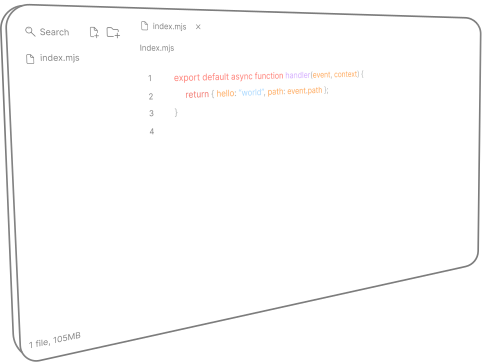
Paste a Handler
Or Deploy From Terminal
In Seconds
- Bundling
- Deploying

Serverless functions, built for production

Isolation
Every run executes in its own microVM with its own kernel. No shared sandbox between tenants.

Releases & rollback
Every deploy is a numbered release. Roll back to any previous version in one command.

Observability
Live logs, per-run history, and invocation metrics, all in the portal.

Cron triggers
Put a function on a schedule with a standard cron expression. Every tick is one signed run.

Secrets
First-class and per-function. Masked on save, and never shown again in full.

Local Support
Best-in-class support handled by Synteq staff. No outsourced help desks.
Frequently Asked Questions
A serverless function is a handler you deploy without managing a server. Synteq runs it when a request, webhook, or schedule triggers it, scales it to zero when it's idle, and bills you only for the runs.
It's the same model: deploy a handler, pay per run, and scale to zero. On Synteq, every function gets its own HTTPS URL out of the box, every run executes in its own microVM on our hardware, and cron triggers are built in.
Node.js 22 and Python 3.12 handlers work out of the box: export a handler and the platform owns the HTTP server. Anything else runs through a Dockerfile, which we build as-is, or a detectable project, which we build with no configuration.
Three ways. Paste a handler into the editor in the portal, initialize and deploy it from a terminal with the Synteq CLI, or upload a source bundle. Each deploy becomes a numbered release.
The first request after idle starts a microVM from a pre-booted pool, which takes about 50-100 ms before your handler runs. After that the instance stays warm for a window after the last request, about 90 seconds by default, and warm requests answer in milliseconds.
Yes. Add a cron trigger with a standard five-field expression and the platform invokes your function on every tick. Each tick is dispatched by the platform's signed scheduler and counts as a single run.
Yes. Every deploy is a versioned release. Roll back to any previous version from the Versions tab in the portal or with one CLI command.
Set variables per function in the portal or the CLI. Mark one as a secret and its value is never shown again in full, only a masked tail so you can tell which one it is.
Functions are for event-driven work: a request, a webhook, a scheduled job. They scale to zero and bill per run. Apps are always-on containers billed by plan tier, for anything that must hold a connection, keep state in memory, or answer with no wake-up at all.
